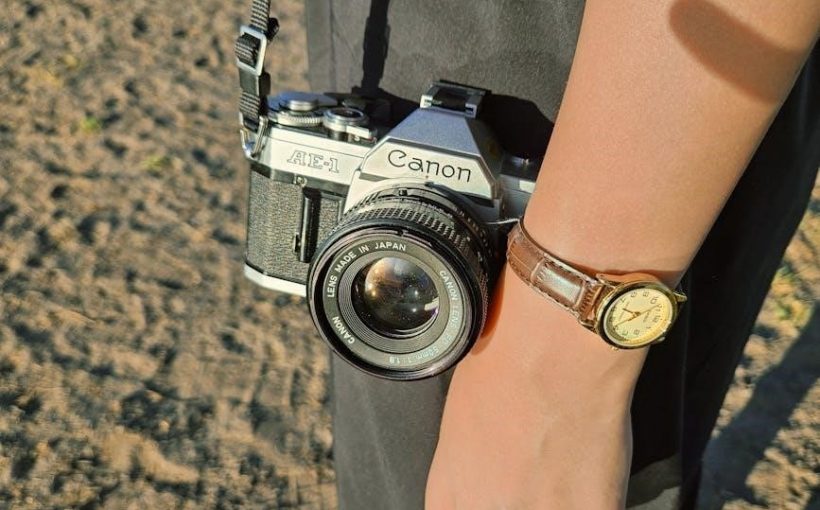
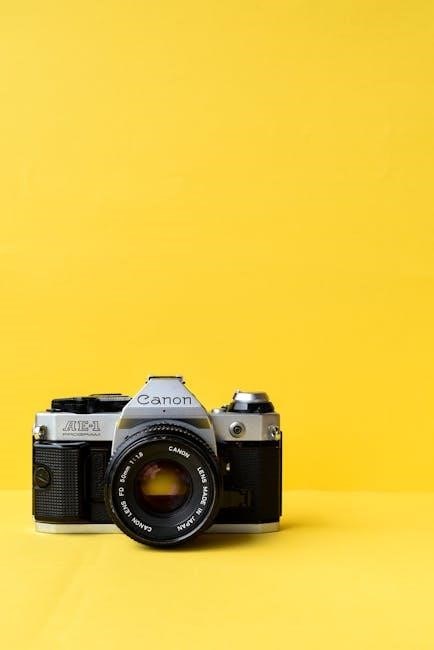
The Canon AE-1 Program, documented extensively online via manuals on the Internet Archive, represents a pivotal moment in accessible SLR photography.
These readily available resources, including detailed service manuals and user guides, demonstrate Canon’s commitment to supporting this iconic camera.
Overview of the Camera
The Canon AE-1 Program, as detailed in freely available manuals from sources like the Internet Archive, is a 35mm single-lens reflex (SLR) camera. It’s celebrated for bringing advanced photographic features to a wider audience.
The camera’s core strength lies in its microprocessor-controlled program exposure mode, simplifying photography for beginners while still offering manual control for experienced users. Manuals showcase its robust build and user-friendly design. The AE-1 Program’s accessibility, coupled with Canon’s extensive lens lineup, cemented its place as a popular choice for both amateur and professional photographers, as evidenced by the wealth of documentation available online.
Historical Context of the AE-1 Program
Launched in 1981, the Canon AE-1 Program arrived as a successor to the original AE-1, building upon its success with enhanced automation. Internet Archive resources, including scanned manuals, reveal it emerged during a period of rapid technological advancement in camera design.
Canon aimed to simplify exposure control, responding to a growing demand for user-friendly cameras. The “Program” mode, a key innovation, automated both aperture and shutter speed selection. This positioned the AE-1 Program competitively against other brands, and its detailed manuals demonstrate Canon’s commitment to educating users about its features.
Key Features and Specifications
The Canon AE-1 Program, as detailed in available manuals, boasts program exposure, shutter priority, and aperture priority modes, alongside full manual control capabilities.
Shutter Speed Range
The Canon AE-1 Program offers a versatile shutter speed range, crucial for diverse photographic scenarios. Manuals detail a range extending from 2 seconds to 1/1000th of a second. This broad spectrum allows photographers to effectively manage motion blur and capture sharp images in varying lighting conditions.
Furthermore, the camera incorporates a Bulb mode for extended exposures, ideal for astrophotography or light painting. The electronic shutter provides precise control, contributing to the camera’s overall reliability and performance, as documented in service manuals.
Aperture Control and Program Mode
The Canon AE-1 Program distinguishes itself with both manual aperture control and a fully automatic Program mode. Manual control allows photographers to precisely dictate depth of field, crucial for creative expression. However, the Program mode simplifies shooting, automatically selecting both aperture and shutter speed for optimal exposure.
User manuals highlight how this mode is particularly beneficial for beginners or fast-paced situations. The camera’s metering system plays a vital role in Program mode, ensuring accurate exposures, as detailed in available documentation.
Film Speed Settings (ISO)
The Canon AE-1 Program accommodates a range of film speeds, typically from ISO 25 to ISO 3200, selectable via a dial on the camera’s top panel. Accurate ISO setting is paramount for correct exposure, as the camera’s metering system relies on this information.
Manuals emphasize the importance of matching the ISO setting to the actual film loaded. Incorrect settings will result in under or overexposed images. The AE-1 Program’s versatility allows photographers to utilize various film stocks for different creative effects.
Understanding the Camera Body
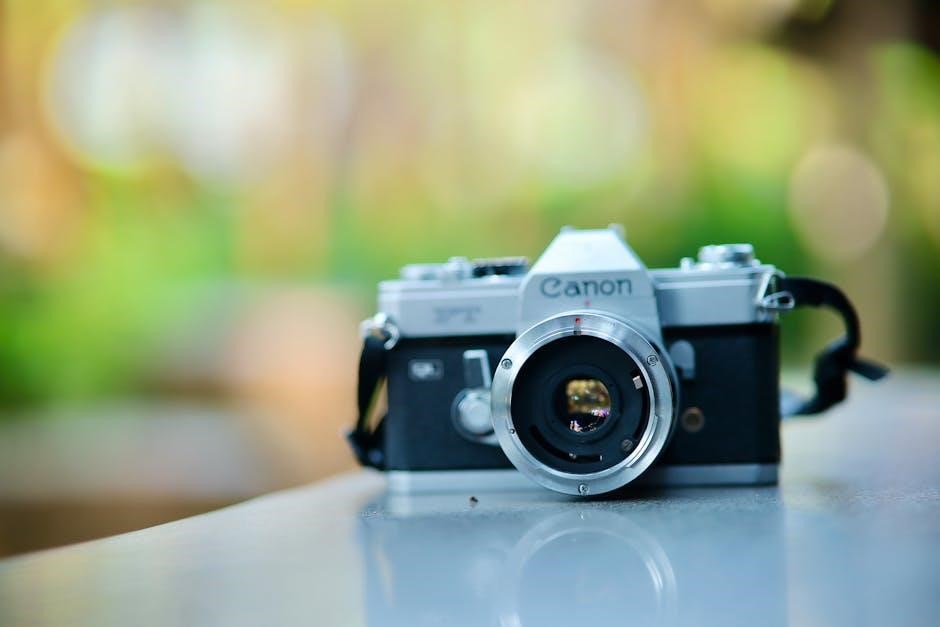
The Canon AE-1 Program’s body, detailed in available manuals, features logically arranged controls for intuitive operation, enhancing the photographic experience for all users.
Top Panel Controls
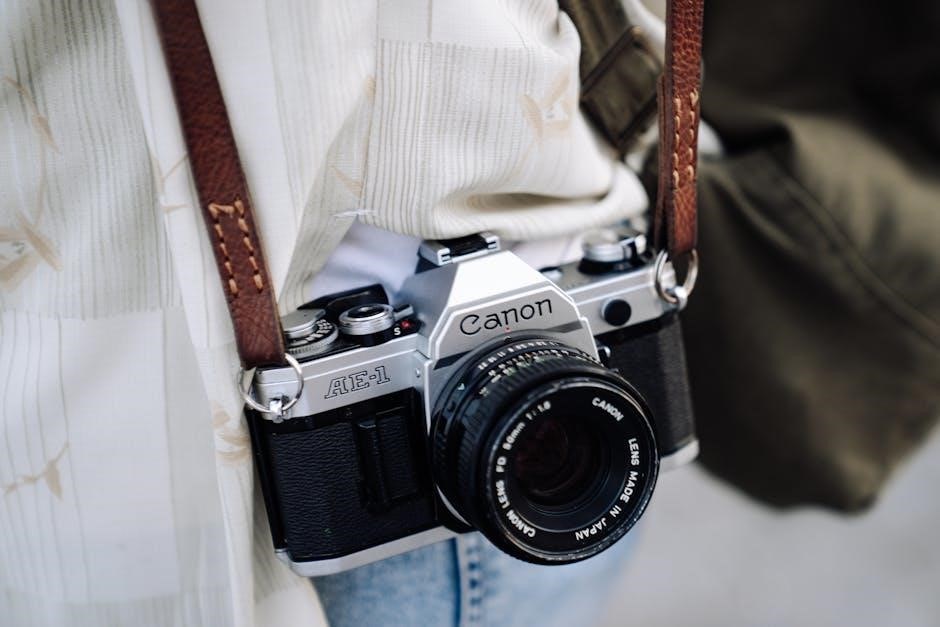
The Canon AE-1 Program’s top panel houses essential controls for operation. The shutter speed dial, prominently positioned, allows selection from a range of speeds, crucial for creative control.
Adjacent to this is the film advance lever, used for cocking the shutter and advancing the film. The rewind crank facilitates film rewinding after exposure.
The hot shoe, designed for external flash units, expands lighting options. The power switch activates the camera’s electronic functions, and the program/manual mode selector enables different exposure control methods, as detailed in the user manual.
Back Panel Layout
The Canon AE-1 Program’s back panel is thoughtfully designed for functionality. The film rewind knob and release button initiate film rewinding after shooting. The film door latch secures the back, protecting the film from light leaks.
The frame counter displays the number of exposures taken, aiding in film management. The diopter adjustment dial, crucial for viewfinder clarity, accommodates varying eyesight.
Access to the battery compartment is also located here, ensuring convenient power source replacement, as outlined in the service manual available online.
Bottom Panel and Battery Compartment
The Canon AE-1 Program’s bottom panel houses the tripod socket, enabling stable long-exposure photography. Crucially, it also contains the battery compartment, accepting standard AA batteries for powering the camera’s electronic functions.
The battery compartment door often features a locking mechanism, preventing accidental opening. Online manuals detail proper battery insertion orientation for optimal performance.
Accessing this compartment is vital for maintaining camera operation, as detailed in service manuals found on resources like the Internet Archive, ensuring continued usability.
Loading and Unloading Film
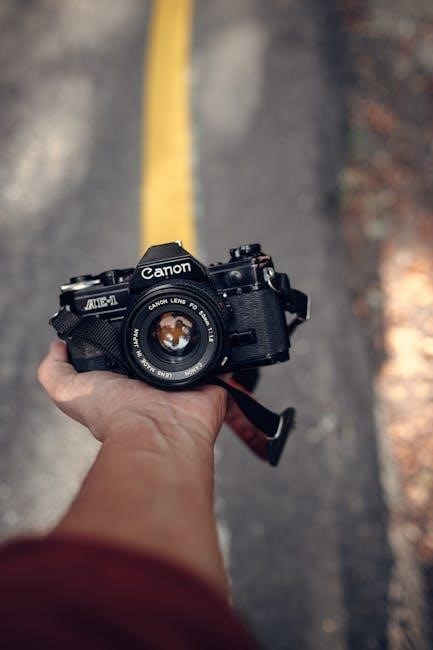
The Canon AE-1 Program manual details a straightforward film loading process, involving the rear panel latch and precise film placement within the chamber.
Film Loading Procedure
According to the Canon AE-1 Program manual available on the Internet Archive, initiating film loading requires releasing the film door latch on the camera’s back panel. Once open, insert the film canister into the chamber, ensuring it seats correctly.
Pull the film leader across the camera body to the take-up spool, and gently advance the film using the film advance lever until the perforations engage. Close the back panel securely; the camera is now ready for shooting. The manual emphasizes careful handling to avoid light leaks and ensure proper film transport.
Film Advance and Rewind
The Canon AE-1 Program manual details a smooth film advance process using the lever on the top panel, progressing with each full stroke. The manual cautions against forcing the lever at the film’s end.
Rewinding the film is achieved via the rewind crank on the camera’s top. The manual instructs to press the rewind release button before turning the crank, ensuring the film retracts fully into the canister. Proper technique, as outlined, prevents damage and ensures complete film retrieval.
Compatible Film Types
The Canon AE-1 Program manual specifies compatibility with 35mm film, encompassing both black and white, and color negative and slide films. The manual doesn’t explicitly limit ISO ranges, but optimal performance is achieved with films between ISO 25 and 3200.
Users can experiment with various film stocks, though the manual doesn’t detail specific recommendations. Proper film loading, as described elsewhere, is crucial for consistent results with any compatible film type.
Exposure Control and Metering
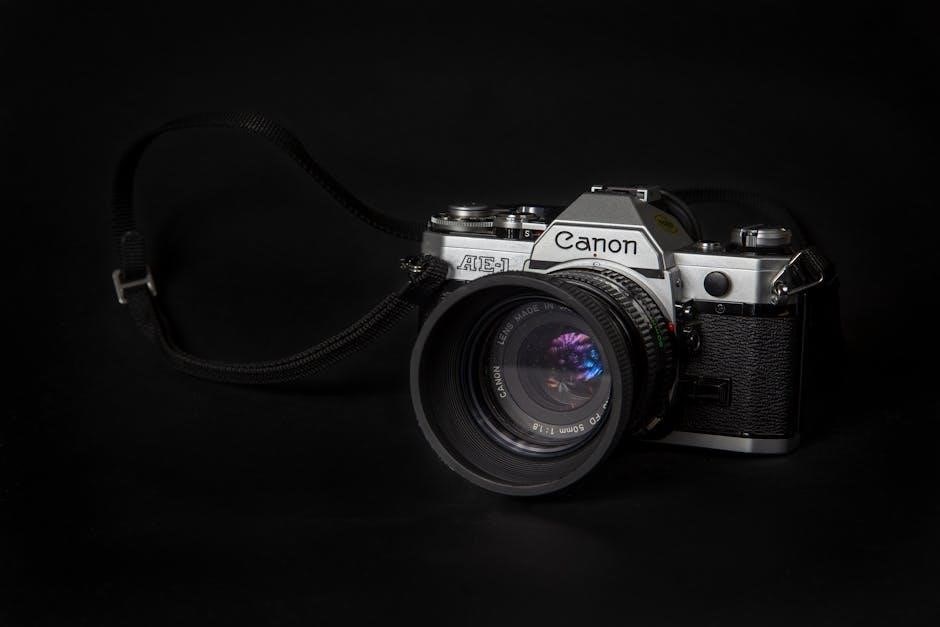
The Canon AE-1 Program manual details program, shutter-priority, and aperture-priority modes, utilizing a center-weighted metering system for accurate exposure calculations.
Program Mode Explained
As the Canon AE-1 Program manual elucidates, Program Mode represents the camera’s fully automatic operation. The camera intelligently selects both the shutter speed and aperture based on its internal metering of the scene’s brightness. This allows photographers to concentrate on composition and focus, rather than technical settings.
However, the manual also notes that Program Mode isn’t entirely inflexible; exposure compensation can be applied to brighten or darken images as desired. This provides a degree of creative control while still benefiting from the convenience of automation. Understanding this balance is key to mastering the AE-1 Program.
Shutter Priority Mode
The Canon AE-1 Program manual details Shutter Priority Mode, allowing photographers to manually set the shutter speed while the camera automatically determines the appropriate aperture for correct exposure. This is invaluable for controlling motion – freezing action with fast speeds or blurring movement with slower ones.
The manual emphasizes that the camera’s metering system will adjust the aperture to achieve a proper exposure based on the selected shutter speed and the scene’s brightness. This mode offers a balance between creative control and automated assistance, ideal for dynamic shooting situations.
Aperture Priority Mode
According to the Canon AE-1 Program manual, Aperture Priority mode empowers photographers to select their desired aperture, influencing depth of field, while the camera automatically sets the shutter speed for proper exposure. A wider aperture (smaller f-number) creates shallow depth of field, ideal for portraits, while a narrower aperture (larger f-number) maximizes sharpness throughout the scene.
The manual clarifies that the camera’s metering system calculates the correct shutter speed based on the chosen aperture and light conditions, offering a blend of creative control and automation. This mode is particularly useful for landscape and still-life photography.
Metering System Details
The Canon AE-1 Program manual details a center-weighted averaging metering system. This means the camera prioritizes light readings from the center of the frame, gradually decreasing sensitivity towards the edges. This approach mimics how the human eye perceives light, often yielding balanced exposures.
The manual further explains that the system operates in both Program and Shutter/Aperture Priority modes, continuously evaluating light to suggest appropriate settings. It’s crucial to understand this weighting for accurate exposure, especially in high-contrast scenes.
Focusing Techniques
The Canon AE-1 Program manual emphasizes manual focusing, utilizing the viewfinder’s split-image rangefinder for precise results. Focusing screen options enhance clarity.
Manual Focusing
The Canon AE-1 Program’s manual clearly details the process of manual focusing, a core skill for photographers using this camera. Utilizing the viewfinder, photographers align images within the split-image rangefinder. This central focusing aid provides a clear visual cue when the subject is sharp.
The manual stresses the importance of precise alignment for optimal image quality. Rotating the focusing ring on the lens until the split image merges indicates accurate focus. Practice and a steady hand are key to mastering this technique, allowing for creative control beyond automated systems.
Focusing Screen Options
The Canon AE-1 Program manual indicates the camera’s focusing screen isn’t directly user-replaceable without specialized tools and expertise. However, different screen options were available at the time of purchase, offering varied focusing aids.
These included variations in the split-image rangefinder and matte patterns. While not a common user adjustment, understanding these options helps appreciate the camera’s customization potential. The manual doesn’t detail screen installation, but acknowledges their existence and impact on focusing precision and viewing experience.
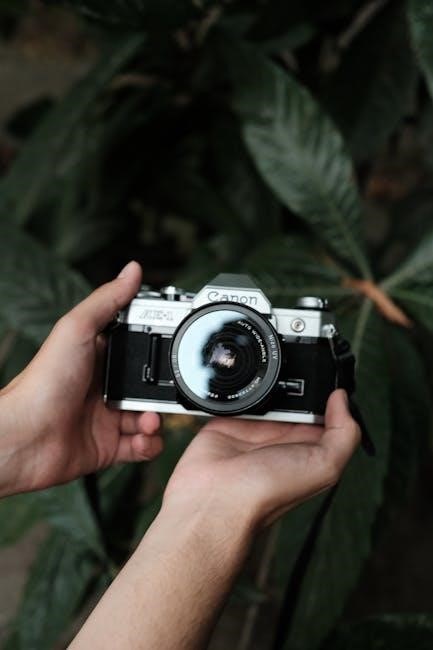
Using the Viewfinder
The Canon AE-1 Program’s viewfinder, as detailed in the manual, displays crucial exposure information and focusing aids for precise image composition.
Viewfinder Information Display
The Canon AE-1 Program’s viewfinder provides a wealth of information essential for accurate exposure and focusing. As outlined in the user manual available on the Internet Archive, users can view the selected shutter speed in Program mode, or the speed set in Shutter or Aperture Priority.
Additionally, the viewfinder incorporates LED indicators displaying over/under exposure warnings when using program mode, assisting in achieving properly exposed photographs. A central focusing spot aids in achieving sharp images, and the manual details how to interpret these visual cues for optimal results.
Diopter Adjustment
The Canon AE-1 Program features a diopter adjustment control, crucial for achieving a sharp viewfinder image tailored to the photographer’s eyesight. As detailed in the readily available user manual on the Internet Archive, this adjustment compensates for nearsightedness or farsightedness.
Located near the viewfinder eyepiece, rotating this control ensures the focus points align precisely with your vision, eliminating the need to wear glasses while shooting. Proper diopter setting guarantees accurate composition and focusing, contributing to consistently sharp and well-framed photographs.
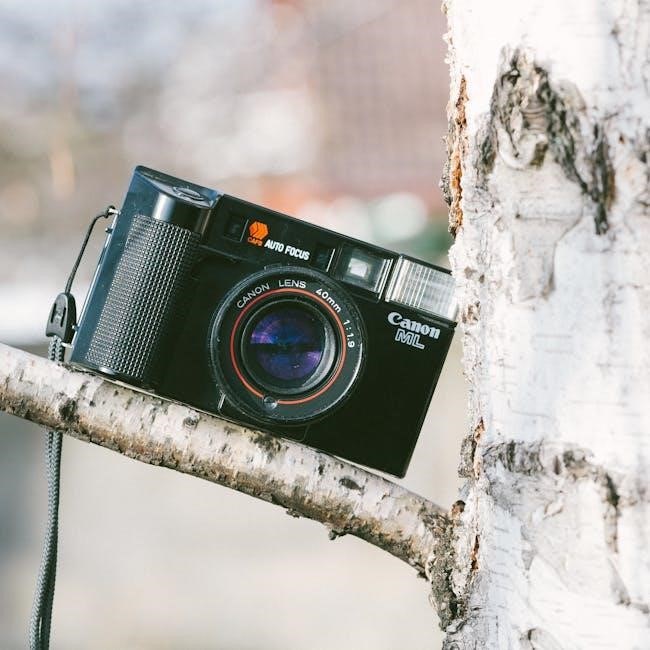
Flash Photography
The Canon AE-1 Program supports both built-in flash functionality and compatibility with external flash units, as outlined in its comprehensive manual available online.
Built-in Flash Functionality
The Canon AE-1 Program features an integrated automatic flash, simplifying photography in low-light conditions. Manuals readily available through resources like the Internet Archive detail its operation. This built-in flash automatically fires when the camera’s metering system determines insufficient ambient light for proper exposure.
Users can override this automatic function for creative control, and the manual provides guidance on flash exposure compensation. The flash is ideal for fill-flash during daylight, balancing shadows and enhancing subject clarity. Understanding its limitations, as described in the documentation, is crucial for optimal results.
External Flash Compatibility
The Canon AE-1 Program offers extensive compatibility with a range of Canon Speedlites and other external flash units, expanding creative lighting possibilities. Manuals accessible via the Internet Archive detail the hot shoe connection and synchronization settings. Utilizing external flashes allows photographers to control flash power, direction, and advanced features like TTL (Through-The-Lens) metering.
The camera supports both automatic and manual flash modes with compatible units. Proper understanding of flash synchronization speed, as outlined in the documentation, is vital to avoid dark bands in images.
Troubleshooting Common Issues
Canon AE-1 Program manuals detail solutions for exposure, film advance, and shutter problems. The Internet Archive provides resources for diagnosing and resolving typical camera malfunctions.
Exposure Problems
Addressing exposure inaccuracies with the Canon AE-1 Program often begins with consulting the comprehensive user manuals available online, notably through the Internet Archive. Incorrect readings can stem from depleted batteries impacting the metering system’s accuracy.
Furthermore, ensure the correct film speed (ISO) is set, as discrepancies here directly affect exposure calculations. Check the viewfinder display for proper metering indications. If issues persist, the service manual suggests potential adjustments to the camera’s internal circuitry, requiring specialized knowledge and tools.
Film Advance Issues
Troubleshooting film advance problems on the Canon AE-1 Program, as detailed in available manuals from resources like the Internet Archive, frequently involves checking for obstructions in the film transport mechanism. Ensure the film is loaded correctly and the sprocket teeth are properly engaged.
A stiff or jerky advance could indicate lubrication issues, potentially addressed with careful cleaning and re-greasing (refer to the service manual). If the film isn’t advancing at all, inspect the rewind knob for proper function and confirm the camera back is securely closed.
Shutter Problems
Addressing shutter issues on the Canon AE-1 Program, as outlined in service manuals accessible via the Internet Archive, often begins with verifying the battery’s condition – a weak battery can cause erratic shutter behavior. If the shutter doesn’t fire, check the shutter speed dial for proper setting.
A slow or inconsistent shutter speed may require professional calibration. The service manual provides detailed instructions for adjusting the shutter timing mechanism, but this is best left to experienced technicians to avoid further damage.
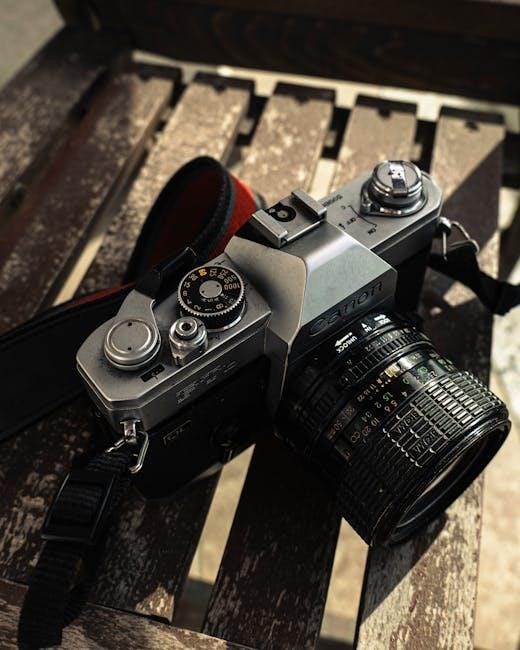
Maintenance and Care
Regular cleaning, detailed in Canon AE-1 Program manuals found online, preserves functionality. Gentle lens care and timely battery replacement are crucial for longevity.
Cleaning the Camera Body
Maintaining the Canon AE-1 Program’s exterior involves gentle practices, as outlined in available manuals. Use a soft, dry cloth to wipe down the body, removing dust and fingerprints. Avoid abrasive cleaners or solvents, which can damage the finish. For stubborn grime, lightly dampen the cloth with distilled water, ensuring no moisture enters the camera’s internal components. Pay attention to crevices around buttons and dials, where dust accumulates. Regularly cleaning the body not only preserves its aesthetic appeal but also ensures smooth operation of controls, contributing to the camera’s overall longevity and reliable performance.
Lens Care
Proper lens care is crucial for maintaining image quality with the Canon AE-1 Program. Use a blower brush to remove loose dust and debris before gently wiping the glass with a microfiber lens cloth. Avoid excessive pressure or circular motions. Specialized lens cleaning solutions can address fingerprints or smudges, applied sparingly to the cloth, not directly to the lens. Regularly clean the lens mount to ensure secure attachment. Protecting the lens with a UV filter can prevent scratches and simplify cleaning, preserving optimal optical performance for years to come.
Battery Replacement
The Canon AE-1 Program utilizes a 4LR44 or equivalent 6V lithium battery. Access the battery compartment on the camera’s bottom panel. Ensure correct polarity when inserting the new battery – positive side up; A weak battery can cause inaccurate metering or camera malfunction. Regularly check battery levels, especially during extended use. Dispose of used batteries responsibly, following local regulations. Maintaining a spare battery is advisable for uninterrupted shooting, ensuring your AE-1 Program is always ready to capture memorable moments.
Advanced Techniques
Mastering depth of field and utilizing filters expands creative control with the Canon AE-1 Program, enhancing photographic expression and artistic vision.
Depth of Field Control
Achieving desired depth of field with the Canon AE-1 Program relies on understanding the interplay between aperture, focal length, and subject distance. A wider aperture (smaller f-number) creates a shallow depth of field, ideal for isolating subjects with blurred backgrounds. Conversely, a narrower aperture (larger f-number) maximizes depth of field, keeping both foreground and background sharp.
Experimentation is key; the manual doesn’t explicitly detail calculations, but practical application reveals how these settings impact image aesthetics. Consider the scene and desired effect – portraiture benefits from shallow depth, while landscapes demand extensive sharpness. Mastering this control elevates your photography beyond automatic modes.
Using Filters
The Canon AE-1 Program accepts filters via the 48mm thread on its FD lenses, expanding creative possibilities. While the manual doesn’t detail specific filter types, common options include UV filters for lens protection, polarizing filters to reduce glare and enhance colors, and neutral density (ND) filters for long exposures in bright light.
Color filters, once popular for black and white photography, can dramatically alter tonal relationships. Experimentation is encouraged; understanding how each filter affects the final image is crucial. Remember to adjust exposure compensation when using ND filters.
Canon AE-1 Program Service Manual Information
Service manuals for the Canon AE-1 Program are accessible online through the Internet Archive, offering detailed diagrams and procedures for repair and adjustment.
Accessing Service Manuals Online
Locating the Canon AE-1 Program service manual is remarkably straightforward thanks to resources like the Internet Archive. A complete service manual, identified as “central-manuals-camera_canon_Ae1p_SM.pdf”, is freely available for download, borrowing, or streaming.
This digital archive provides access to crucial documentation for technicians and enthusiasts alike, offering detailed schematics and adjustment procedures. The Internet Archive utilizes OCR technology (Tesseract 5.3.0-6-g76ae) to ensure the manual is searchable, enhancing usability.
Furthermore, the platform assigns unique identifiers (ark:/13960/t8bh25g2b) for easy referencing and preservation of this valuable resource.
Common Service Adjustments
The Canon AE-1 Program service manual, accessible online, details procedures for testing and adjusting various camera functions. These adjustments, crucial for maintaining optimal performance, cover areas like exposure accuracy and film transport reliability.
The manual provides diagrams and step-by-step instructions for calibrating the metering system, ensuring correct aperture and shutter speed settings. It also outlines how to troubleshoot and repair common issues related to the film advance mechanism and shutter operation.
Precise calibration is essential for consistent results.
Resources and Further Learning
Online forums and communities, alongside Canon’s official support website and the Internet Archive’s manual collection, offer invaluable resources for AE-1 Program users.
Online Forums and Communities
Numerous online platforms dedicate space to the Canon AE-1 Program, fostering a vibrant community of enthusiasts and experienced users. These forums serve as excellent resources for troubleshooting, sharing knowledge, and discovering advanced techniques.
Users frequently upload scanned manuals, offer repair advice, and discuss modifications. Websites like Reddit (specifically photography subreddits) and dedicated classic camera forums provide active discussions. The Internet Archive, hosting both user manuals and service manuals, is a central hub for information.
Engaging with these communities allows owners to learn from others’ experiences, find solutions to common issues, and deepen their understanding of this classic camera.
Canon’s Official Support Website
While the Canon AE-1 Program is a vintage camera, Canon’s official support website offers limited direct resources for this specific model. However, the site provides valuable information regarding Canon’s history and broader photography principles.
Users seeking manuals will find that Canon primarily focuses on current product lines. Despite this, the website’s FAQ sections and general photography guides can be helpful for understanding core concepts applicable to film photography.
For AE-1 Program specific documentation, enthusiasts largely rely on community-driven resources and archived materials like those found on the Internet Archive.